
Coastguard Dunedin
Unit Finalist
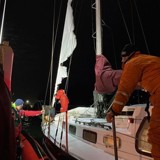
On July 28, with a severe weather event approaching, a sailing vessel was returning from a hunting trip on Stewart Island, bound for Otago Harbour with two crew. 2.2 nautical miles from Tairoa Heads the engine failed. Sails were deployed and were immediately shredded in the gale force winds. The crew were battered and seasick from trying to restart the engine.
At 5:30pm, Moana Rescue set off. Conditions were dark with heavy low cloud cover, no moon, and horizontal rain, but at 7pm they located the vessel and despite the atrocious conditions, made plans to set up a tow.
Moana Rescue approached from upwind to avoid lines dangling in the water from the shredded jib. The tow line was passed to the Skipper and secured to the forward deck bollard. Suddenly, Moana Rescue was struck by a wave that spun the boat, exposing her stern to the waves and wrapping the tow line around the outboard motors. The helm had the presence of mind to bring Moana Rescue back into the weather, turning off one engine then the other, and the Deckhand freed the line to reset the tow. Slowly, and with great skill and teamwork, Moana Rescue successfully delivered the vessel and her crew to the safety of Otago harbour.
Coastguard Hawke's Bay
Unit Finalist
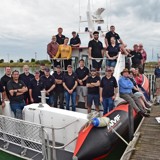
This is a great example of skill and professionalism in extremely challenging conditions, one which deserves to be recognised. It starts with the vessel Gitan II on a delivery voyage from Auckland to Wellington with three people on board. At night, near the Lachlan Ridge, 42 nautical miles off Napier, they struck a damaging southerly front that saw them drop off a wave with shattering force, breaking windows and injuring the crew.
Experienced Coastguard Hawkes Bay volunteers onboard Celia Knowles, equipped with radar, night vision and a FLIR camera launched at 9:21pm, locating the stricken vessel at 11:49pm. In 20-25 knot winds and 2-3 metre seas the decision was made to remove the three crew, one by one in the dark. This took incredible skill, patience and determination, but with the ship approaching the pounding shoreline it was the right call. Happily, they were successful, and all crew were delivered to waiting medical emergency staff on land. The Gitan II washed ashore not long after.

Coastguard South Taranaki
Unit Finalist
On March 10, off the South Taranaki coast, a 7-metre aluminium boat reported a diver missing. Skipper Scott Williams arrived at Patea boat ramp as the team assembled, then made their way at speed towards the site, approximately 5 nautical miles offshore from the Patea bar.
For the next 5 days and approximately 900 hours, with bad weather hampering their rescue efforts, the crew remained focussed on the search and hopeful rescue of the diver. Sadly, by March 13 the crushing realisation set in that the unit was now into a body recovery operation, a situation that placed everyone involved under immense strain. Being part of a small community, some crew members had personal connections with the victim and his whānau.
The unit have since been the recipients of a school-wide fundraising day organised by the victim's son in Patea School. The unit will be presenting the school with a plaque of appreciation, further strengthening the whanaungatanga (kinship) with the school, students and family involved.

Coastguard Wellington
Unit Finalist
The routine call came through – a 20ft yacht had broken down 4.5 nautical miles (Nm) off Bearing Head with torn sails and no propulsion. With the unit’s newest skipper Warwick Bayne in command, Spirit of Wellington launched from Evans Bay at 8:30pm. Conditions were N/NW 20-25 knot winds and a sea of 1-1.5m, both rising. Attempts to hail the yacht on VHF were unsuccessful, but a nearby ferry provided an updated RADAR position. At 9:50pm the crew had a visual and, after a risk assessment, a line was successfully passed to the vessel so that the 18Nm tow to safety could begin, albeit at a slow 2-4kts.
However, at 1:05am the tow line parted at the yachts’ end, splitting the fuse. With the yacht now drifting towards rocks near Pencarrow Head, the crew quickly recovered the tow line, attaching a new fuse and the replacement was again safely fastened to the vessel. Hours later, the yacht was eventually pulled alongside for a barge and safely back at Evans Bay Marina at 3:40am. Of mention is Skipper Warwick who did an excellent job for his first time – and his skill testament to the wider Coastguard training curriculum.